


Warts are flat, keratinized, benign growths caused by the human papilloma virus.This fairly common disease most often occurs in children and adolescents and is an epidermal tumor with a diameter of several millimeters to several centimeters.
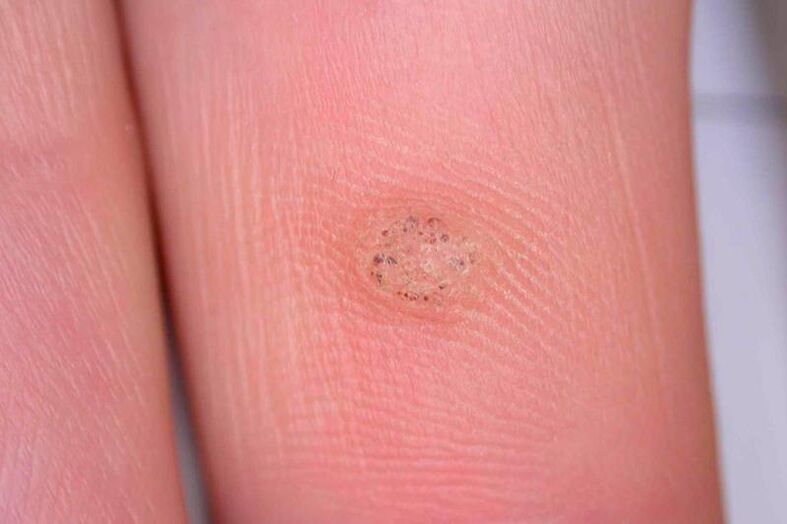
Warts can affect the skin of the hands, feet and face, as well as the mucous membranes and genitals.This disease is very contagious: it spreads quickly and is transmitted from one person to another.When injured, warts become painful and may change color and shape.In addition, such neoplasms create a certain psychological discomfort and are an aesthetic defect.Improper treatment can lead to the formation of rough scars and scars.In some cases, warts can develop into malignant tumors.
Cause of warts and pathogenesis
Warts are caused by a filterable virus.It cannot be examined under a microscope or “captured” by bacterial filters.These viruses include the human papillomavirus (HPV).Anyone can become infected, but some people are more likely to be infected than others.To date, more than 120 human papillomaviruses have been studied.We know that types 2 and 4 viruses cause warts.These types of viruses are particularly associated with the appearance of warts on the hands.
Constant use of a sauna, swimming pool, public beach or gym can cause HPV infection.Additionally, if a person's professional activity involves periodic contact with fresh meat or fish, they may not feel safe.
You can become infected both through contact with a carrier of the virus and through household means by sharing household items with an infected person.Warts spread especially quickly in children's groups (kindergartens, schools, sports sections, etc.).Maceration (natural swelling of the epidermis, which occurs in people exercising certain professions) or minor skin lesions are considered predisposing factors.The incubation period can last from 5 to 6 to 16 weeks.Typically, human papillomavirus infection is asymptomatic and often goes unnoticed by the patient.
But what is the common cause of the appearance of warts on the fingers?Undoubtedly, human fingers are the most traumatized area of the body, through which the virus is transmitted so quickly and easily, which causes the appearance of warts.Contact with a carrier of the virus (mainly the cause of warts) is made by shaking hands or by contact with handrails or balustrades in public places.An interesting fact is that a person infected with such a virus may not even realize its presence.He discovers it when a wart appears.In addition, the cause of warts is often a decrease in human immunity.As practice shows, even if a person manages to strengthen his immunity, the warts do not disappear anywhere, since the virus continues to live in the blood, causing the warts to reappear.
Types of warts
In dermatology, it is customary to distinguish between common, plantar, senile and flat (juvenile) warts.Each type of wart has its own characteristics.
Ordinary type
Outwardly, common warts look like non-inflamed nodules, small in size and dense in consistency.Common warts are flattened or hemispherical in shape and may be slightly dark or have the color of normal skin.Most often, these warts are localized on the hands, palms, face and other areas of the skin.In most cases, these tumors are painless.The exception is warts located in the nail area.They will be quite painful and difficult to treat.Typically, these warts appear during childhood.
Causes of common warts
What are the reasons for the appearance of common warts in children?It's simple: the cause of a wart can be an ordinary scratch or abrasion, through which the human papilloma virus (HPV) penetrates the skin.After entering the body, the virus begins to actively multiply, concentrating mainly in the basal layer of the skin, which causes the first warts to appear after a month or two.It is important to note that the appearance of a wart may not be an obligatory symptom of the development of this virus in a child's body.If a child has a strong immune system, he may not be able to reach an extremely severe form of the disease, in which warts appear one after another.The virus will simply live in the body, without manifesting itself in any way externally.
If we have discovered the reasons for the appearance of common warts, we must now talk about the symptomatic characteristics.As you know, these warts usually appear on the back of the hand or foot.An ordinary wart has a round shape, the size of which does not exceed 10 mm.An important feature of this type of wart is its multiple nature: the appearance of one can affect the formation of a second wart, and in the future their number will only increase.
Another interesting fact is that the causes of the appearance of common type warts are the warts themselves.This means that next to one common wart, a second often appears.The latter is commonly called the “kissing” wart.
Plantar type
Plantar warts can appear in both adults and children.Because plantar warts are not immediately detected, they are difficult to treat.These neoplasms are located in areas of greatest pressure.They hinder walking, are very painful and can reach the size of a chicken egg.Sometimes patients mistake keratinized plantar warts for calluses or skin abrasions.A wart differs from a callus by the presence of papillary growths.
Type of flat warts
Juvenile flat warts are small, yellowish or pale pink epidermal tumors.Most often, these warts appear on the patient's forehead, chin or cheeks, as well as on the neck and hands (usually on the back).There are two types of juvenile warts: filiform and flat papillomas, located on the mucous membranes
Type of senile warts
Senile warts affect patients of both sexes from the age of 40.Localization of the pathological process occurs in closed areas of the skin: abdomen, back and chest.Senile warts are flat in shape and covered with characteristic scales.If the scales are removed, papillary growths become visible.
Diagnosis of warts
Diagnosing warts is not particularly difficult for an experienced dermatologist.These tumors have characteristic external signs, so it is difficult to confuse them with something else.However, common wart should be differentiated from keratoma, nevus, tuberculous skin lesions, verrucous basal cell carcinoma, polyps, calluses, skin cancer and other dermatological diseases.
To definitively confirm the differential diagnosis, the patient may be ordered additional blood tests to detect human papillomavirus (HPV).This study is carried out using the polymerase chain reaction (PCR) method.
Treatment of warts
Before starting treatment, you must definitely consult a doctor.Only a specialist can make the correct differential diagnosis and prescribe adequate treatment.There are many "grandmother's recipes" against warts, but trying them on yourself is not only unwise, but also very dangerous for health, because a wart is not just a cosmetic defect, but a very serious disease.
Treatment of various warts is aimed at eliminating them.The method of destroying warts is chosen individually, taking into account the localization and nature of the pathological process.Warts are often multiple, but it is often enough to remove a “mother” tumor for all the others to disappear on their own over time.Warts, the treatment of which with conservative methods proved ineffective, are subject to destruction.
Basic methods for destroying warts
There are a number of gradual methods for destroying warts.The most effective of them are:
- Cryodestruction.This method is based on the application of liquid nitrogen or dry ice directly to the wart.The damaged area of skin is frozen, after which it is rejected.When exposed to extremely low temperatures, the virus dies completely and the wart is destroyed.This method is painless and postoperative scars are almost invisible.If the wart is large or if the patient has a very high sensitivity threshold, the doctor may then decide to use local anesthesia.After the operation, a black crust forms at the site of the wart, which should not be removed in any case.After 4 to 5 weeks it will be rejected on its own.If the wart was very large, the affected area is re-treated after 3 to 4 weeks.
- Electrocoagulation.This method involves burning the tumor with an electric current.Electrocoagulation is used in hard-to-reach areas and can be used to remove warts on the mucous membranes.The disadvantages include a relatively long list of contraindications: violation of the general somatic state, individual intolerance to anesthetics, inflammatory skin diseases, etc.
- Laser destruction of warts.This is the most progressive method for removing warts of any kind.The duration of the operation is only a few minutes.The postoperative wound heals quickly and does not require special care.After the operation, no trace of the wart remains.There is no age limit;This method can also be used to treat warts in young children.
- Surgical excision of warts.It is used less and less, only to eliminate particularly large warts.The method is quite painful, accompanied by heavy bleeding, and the postoperative wound often does not heal well, leaving a scar.
- X-ray irradiation. This method is used to treat plantar warts.
However, treatment of warts can be not only surgical, but also medicinal.Today, for the treatment of different types of warts, there are a number of topical medications that can destroy the structure of the wart, thus corresponding to local treatment.Often, treatment of warts is possible using a special ointment that will remove the wart quickly and painlessly.
The treatment of warts consists primarily of destroying the growths formed on the surface of the skin.Drug treatment corresponds to medications that can be classified into several groups:
- Necrosing;
- Keratolytics (a number of medications that help treat the wart by melting it away).
- Components for cryotherapy.
- Various antiviral drugs.
- Medicines that can strengthen immunity.
Treating warts using the above remedies may not give immediate effect.Repeated use of medications may be necessary to remove a wart.However, in a number of other cases, treatment of warts is not necessary at all: after a while they disappear on their own.
According to statistics, self-healing occurs no later than 2 months after the appearance of the first wart (about 20-22% of all cases) or 3 months (30% of cases).If we are talking about an older wart, it is most likely that self-healing will occur after 2 years (and this accounts for 50% of cases).Adults are least likely to respond to self-treatment.Treatment of warts in adults is facilitated by medication or surgical interventions.
Treating a wart can be complicated due to its unpredictable behavior.The reason for such complicated treatment may be a late visit to the doctor, when the wart has grown, changed shape or color.Usually a second wart quickly appears near one wart, and then their number increases, which also complicates treatment.
If wart treatment is done correctly, it will either result in the wart disappearing completely or gradually disappearing.At the same time, you should not be afraid of the appearance of a new wart.